
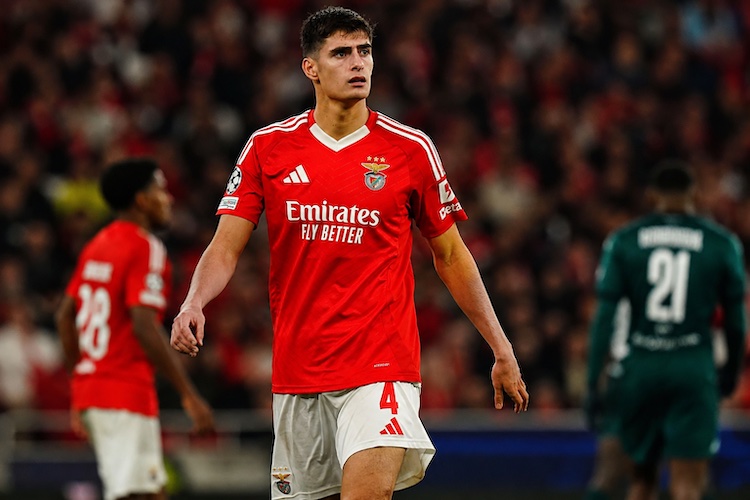
AFC Bournemouth are closing in on the signing of Portugal international António Silva after the highly rated Benfica centre-back reportedly completed his medical.
The 22-year-old arrives with more than 180 senior appearances, Champions League experience and 20 caps for Portugal, despite still being several years away from the traditional peak age for a central defender.
António Silva transfer latest
Silva has reportedly completed his medical ahead of a permanent transfer from Benfica to AFC Bournemouth.
The deal is understood to be worth an initial €25 million, approximately £21.4 million, with a further €5 million potentially due through performance-related add-ons.
The Portugal international is also reported to have agreed a contract running until June 2031.
Although the medical and contractual formalities are believed to have been completed, the transfer should continue to be treated as subject to official confirmation from AFC Bournemouth and Benfica.
Should the deal be announced as expected, it would represent one of the most eye-catching defensive signings in Bournemouth’s history.
Silva was previously protected by a €100 million release clause and has regularly been linked with some of Europe’s biggest clubs.
António Silva career profile
- Full name: António João Pereira de Albuquerque Tavares da Silva
- Date of birth: 30 October 2003
- Place of birth: Viseu, Portugal
- Age: 22
- Height: Approximately 1.87 metres
- Position: Centre-back
- Preferred foot: Right
- Previous club: Benfica
- International team: Portugal
Despite his age, Silva has already accumulated more senior experience than many defenders several years older than him.
Since breaking into Benfica’s first team in 2022, he has made more than 180 competitive appearances, scored 10 goals and featured extensively in domestic and European competition.
He has played in title races, Lisbon derbies, Champions League knockout matches, a World Cup and a European Championship.
From Viseu to the Benfica academy
Silva was born in Viseu, a city in northern central Portugal, and began playing football with local clubs including Penalva do Castelo, Repesenses and Viseu United.
Benfica recruited him for their academy in 2016, when he was around 12 years old.
The move placed him inside one of Europe’s most successful youth-development systems. Benfica’s academy has helped produce players including Rúben Dias, Bernardo Silva, João Félix, João Neves, Renato Sanches and Gonçalo Ramos.
Silva’s early years away from home were not entirely straightforward. He reportedly struggled with homesickness and temporarily returned to Viseu before going back to Lisbon to continue his development.
His decision to persevere was eventually rewarded as he progressed through Benfica’s age groups and became a leader within the club’s academy teams.
He was one of the captains of the Benfica generation that won the 2021/22 UEFA Youth League.
Benfica defeated Red Bull Salzburg 6-0 in the final, securing the trophy for the first time in the club’s history. Silva started in central defence alongside Tomás Araújo, another player who later progressed into Benfica’s senior side and the Portugal squad.
The first-team breakthrough that changed his career
Silva’s rise from youth football to Benfica’s senior team was remarkably quick.
He made his first-team debut on 27 August 2022, starting in a 3-0 league victory away to Boavista.
His opportunity initially came because Benfica were dealing with injuries and suspensions in central defence. However, Silva performed with such confidence that manager Roger Schmidt continued to select him.
Only days after his league debut, Silva made his first Champions League appearance in a 2-0 victory over Maccabi Haifa.
Playing alongside experienced Argentina international Nicolás Otamendi, the teenager looked composed in possession and rarely appeared overwhelmed by the occasion.
He completed his breakthrough campaign with 44 appearances and five goals in all competitions.
Benfica went on to win the Primeira Liga title, ending a four-year wait to become Portuguese champions.
Silva was subsequently selected in the Primeira Liga Team of the Season for 2022/23 and finished eighth in voting for the 2023 Kopa Trophy, awarded to the world’s leading player under the age of 21.
Champions League performances established his reputation
Silva’s performances in the Champions League helped transform him from a promising academy graduate into one of Europe’s most talked-about young defenders.
Benfica were drawn in a group containing Paris Saint-Germain, Juventus and Maccabi Haifa during the 2022/23 competition.
Rather than simply attempting to survive, the Portuguese side finished above both PSG and Juventus and progressed as group winners.
Silva produced one of the defining moments of his breakthrough season when he scored the opening goal in Benfica’s dramatic 4-3 victory over Juventus in Lisbon.
He was only 18 at the time.
Benfica eventually reached the quarter-finals, where they were eliminated by Inter Milan. Silva scored again during the second leg at San Siro, heading home in a 3-3 draw.
His performances demonstrated that he could cope with elite-level pressure, defend in a high line and contribute to his team’s build-up play against strong opposition.
He followed that campaign with 50 appearances in all competitions during 2023/24 as Benfica finished second domestically and reached the Europa League quarter-finals.
His progress has not been completely linear since then. Competition for places increased, while the extraordinary expectations created by his teenage breakthrough meant solid performances were sometimes judged harshly.
Nevertheless, reaching more than 180 Benfica appearances by the age of 22 remains an exceptional achievement.
Portugal international career
Silva represented Portugal at under-16, under-17, under-18, under-19 and under-21 level before being promoted to the senior squad.
He made his full international debut in November 2022, starting in a 4-0 friendly victory over Nigeria.
His promotion came only a few months after his Benfica debut, illustrating how quickly his reputation had developed.
Silva was then selected for Portugal’s squad at the 2022 World Cup in Qatar.
He started the final group match against South Korea and became Portugal’s youngest-ever player at a World Cup, aged 19 years and 33 days.
His international career has also included difficult experiences.
Silva started Portugal’s final group match against Georgia at Euro 2024. An early mistake contributed to Georgia’s opening goal before he later conceded the penalty from which they made it 2-0.
He did not feature again during the tournament, but the performance came while he was still only 20 years old.
Errors by central defenders are often magnified because they frequently lead directly to chances or goals. Silva’s response to those setbacks will form an important part of his development.
He remained part of Portugal’s wider senior setup and had earned 20 caps by 2026.
What type of defender is António Silva?
Silva is best described as an intelligent, proactive and technically confident centre-back.
He is not a defender who depends entirely on size, strength or recovery pace. His game is built around anticipation, positioning and reading the intentions of opposing players.
Rather than waiting for an attacker to receive the ball, Silva frequently attempts to step forward and intercept the pass before the move can develop.
This proactive approach allows his team to regain possession higher up the pitch, but it also requires excellent timing. If a defender steps forward too early and misses the ball, space can be left behind him.
Silva is also comfortable receiving possession under pressure and progressing the ball from defence.
He regularly looks for vertical passes into midfield rather than simply moving the ball sideways between defenders.
He is capable of switching play with longer diagonal passes and has experience operating on either side of a centre-back partnership or within a three-man defence.
António Silva’s key strengths
Anticipation
Silva’s ability to read danger early is arguably his greatest strength.
He often positions himself to intercept passes or challenge attackers before they can turn towards goal.
Composure in possession
He is comfortable receiving the ball from his goalkeeper and playing through an opposition press.
That composure should be valuable to a Bournemouth side expected to build attacks from the back.
Progressive passing
Silva does not restrict himself to safe passes. He attempts to break defensive lines by finding midfielders between opponents or switching play towards advancing full-backs.
Experience at a young age
More than 180 senior club appearances, Champions League football and 20 international caps give him a level of experience rarely associated with a 22-year-old defender.
Tactical flexibility
Silva has experience playing as the right or left-sided central defender and can also operate in a back three.
Leadership potential
He captained Benfica youth teams and was trusted in major matches as a teenager, suggesting he has the mentality required to accept responsibility.
Areas Silva will need to improve
Silva arrives with considerable potential, but adapting to the Premier League will still present major challenges.
Physical duels
At approximately 1.87 metres, Silva is not small, but he will regularly face powerful Premier League forwards who specialise in direct running, aerial challenges and holding up the ball.
He will need to use his positioning and timing effectively when facing physically dominant strikers.
Defending transitions
Benfica dominate possession in most domestic matches. Bournemouth will encounter more frequent counter-attacks and periods without the ball.
Silva will need to adapt to defending larger spaces and reacting quickly when possession is lost.
Concentration
His proactive style can occasionally create risk when he steps out of defence at the wrong moment.
The Premier League’s speed means even a small positional mistake can be punished immediately.
Consistency
Silva’s early breakthrough created enormous expectations. His challenge at Bournemouth will be to reproduce his best performances consistently across a demanding domestic and European schedule.
Why António Silva could suit Marco Rose
Silva appears well suited to the style of football Marco Rose is expected to implement at Bournemouth.
Rose’s teams have traditionally played with intensity, pressed aggressively and attempted to regain possession high up the pitch.
That approach requires defenders who are willing to hold a high line, step into midfield and make confident decisions away from their own penalty area.
Silva’s anticipation-based defending could therefore be particularly valuable.
His ability to play forward passes should also help Bournemouth move quickly from regaining possession into attack.
Rose will nevertheless need to provide Silva with a stable defensive partnership and clear protection from midfield while he adjusts to English football.
The defender’s first few months may involve a learning curve, but his tactical background at Benfica gives him a strong platform from which to develop.
Why Bournemouth have targeted António Silva
The signing fits Bournemouth’s established recruitment model.
The club have increasingly targeted young players who already possess significant first-team experience but retain substantial development and resale potential.
Silva is only 22, but he does not arrive as an inexperienced prospect requiring several seasons before he can contribute.
He has already competed at the highest level, won a domestic title and represented one of Europe’s strongest international teams.
At the same time, his development has reached a point where a change of environment may be beneficial.
At Benfica, Silva was constantly compared with the 18-year-old who appeared almost fully formed during his first Champions League campaign.
At Bournemouth, he can be assessed as a young defender adapting to a new country, league and tactical system.
The reported fee also reflects the opportunity Bournemouth believe they have identified.
Paying up to €30 million for a 22-year-old Portugal international with more than 180 Benfica appearances could prove excellent value if Silva rediscovers the momentum of his breakthrough season.
Bournemouth’s recent record of developing central defenders should also have helped persuade the player.
The club have shown they can give talented young defenders Premier League exposure, significant tactical responsibility and a pathway towards the highest level of European football.
Bournemouth Daily verdict
António Silva should not be presented as a guaranteed success, but his signing represents an ambitious and calculated piece of recruitment.
There are understandable questions about how quickly he will adapt to the physicality and speed of the Premier League.
There have also been moments in his career when individual errors have attracted significant criticism.
However, those concerns must be considered alongside the extraordinary amount Silva has already achieved.
Few 22-year-old defenders arrive with more than 180 appearances for a major European club, extensive Champions League experience, a domestic league title and 20 senior international caps.
His reputation may have fallen slightly from the exceptional level reached during his first Benfica season, but that decline in market perception is precisely what has created the opportunity for Bournemouth.
Silva remains young enough to develop substantially while being experienced enough to compete for a starting position immediately.
If Marco Rose can build his confidence, improve his consistency and help him adjust to the Premier League, Bournemouth may have secured one of the most impressive defensive signings of the summer.
For the Cherries, it is another statement of intent.

